Most countries in the Americas have adopted or are discussing broad strategies or regulations on artificial intelligence (AI). Cullen International’s latest research shows that AI policy has been a key issue for the region, with important decisions on the horizon.
The US’ recently published AI Action Plan outlines over 90 federal policy actions nominally designed to help the USA achieve global AI “dominance”. These actions are organised around three pillars: accelerating AI innovation; building American AI infrastructure; and leading international AI diplomacy and security.
Other countries in the region are also taking significant steps towards defining their AI policy goals and regulations. Canada consulted on the future direction of its AI strategy with a view to maintaining AI “leadership”.
The Colombian government introduced a broad AI bill, drawing on previous legislative proposals and inputs from academia, the private sector, and civil society.
A bill on AI is also under discussion in the Brazilian Congress. If approved, the bill would impose transparency and ethical obligations on AI developers, and require them to conduct risk-mitigating measures.
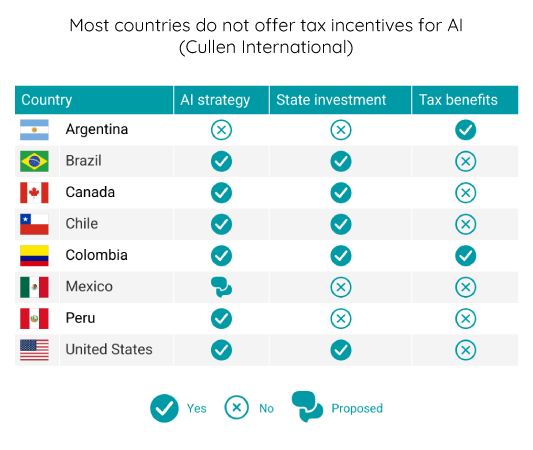
The strategies for fostering AI vary across the region. Some governments invest in AI research, workforce skills, and access to computing hardware. Argentina and Colombia are the only countries to offer tax incentives for AI developers.
To access the full benchmark, please click on “Access the full content” - or on “Request Access”, in case you are not subscribed to our Americas Digital Economy service.
more news
01 December 25
Lithuanian regulator plans local regulatory holidays in the wholesale local access market
FREE download for ALL of our latest analysis!
01 December 25
Cullen Explainer: Satellite direct-to-device services
Our new Explainer provides an overview of the technical background of satellite direct-to-device (D2D) and the operators providing or preparing such services.
28 November 25
Global trends in countering online scams in 2025
Our latest Global Trends report highlights that several jurisdictions around the world adopted or proposed in 2025 new legislation and policies aimed at countering online scams. The focus of those initiatives regarded various aspects, ranging from prevention and enforcement aspects to mechanisms to compensate scam victims.